by Stephen Hu, mathematics
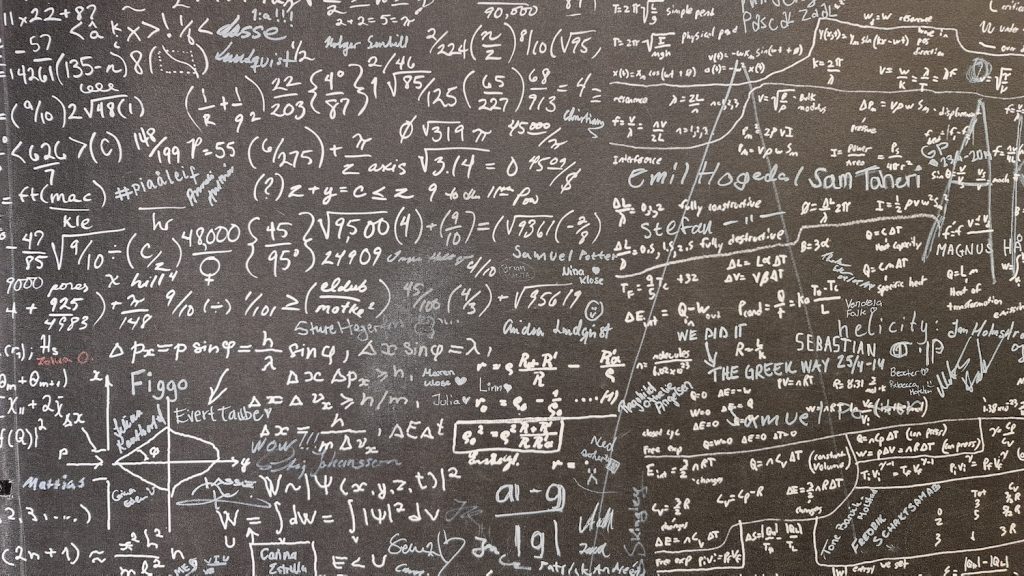
I was talking with an undergraduate friend earlier who was majoring in art, commiserating about how people react to our majors. Generally people react somewhat negatively when I say I do math, saying “How is this useful?” However, my friend said, “At least people have some idea that math is useful.” The thought gave me pause—it’s true that math has a myriad of potential applications from accounting to history, and our modern world wouldn’t be the same without it. However, this doesn’t represent how pure mathematicians think and do math. Pure math is a field that should arguably be in the humanities, more in common with its brethren in philosophy and comparative literature than the hard sciences like biology or chemistry. Indeed, the STEM acronym masks the idea that math can be done for its own sake, instead grouped in with its applications in its other fields. Pure math is math created by mathematicians, done for mathematicians. Oh, and maybe it finds some use somewhere else.
For similar reasons, it always bothered me when people said to me, “I loved math! It was always so exact and precise, and there was always a right answer. It’s either right or wrong!” While true to some extent, I don’t believe that this truly matches the reality that most mathematicians live. Math as taught in school is a set of arcane rules and assumptions which are passed down almost like gospel, with bedeviling word problems and confusing jargon. I doubt most people would call math a creative endeavor. However, that couldn’t be further from the truth! Mathematics is all about asking questions, creating your own rules, and seeing what happens. Far from being a sterile subject, math to me has always been a place where you make the rules and see what happens. While it’s true that certain rules are followed, they’re subject to the whims of “what seems interesting” to our minds. It’s the difference between being stuck in a maze of ropes versus tackling the fun rope structure at the playground. While they ostensibly look the same, they feel very different. One is a cage trapping you, while the other is a challenging obstacle course meant to be navigated and solved.

The true heart of mathematics isn’t terrifying calc classes but intense conversations with a friend over dinner, scribbling on napkins. It’s the late-night breakthroughs which we hastily type up so we won’t forget it. It’s the perseverance and practice that lets us unfold the questions we ask and sit at the top, basking in our triumph.
No wonder why mathematicians love rock climbing so much; the feeling of tackling an obstacle and conquering it feels very familiar. And the way we talk and write to each other is very unique! Mathematics has its own language. I don’t just mean the symbols and equations which many people associate with math, but also the way we speak and talk and, by proxy, write about what we do. Here at UGA and many similar institutions, you can take an introduction to proof class, a place where non-acolytes can learn to speak mathematically and create coherent mathematical arguments. Writing down such arguments is as much about style if anything else—if a proof is correct but too dense or overly verbose, no one will want to read it. Learning the precise mix of rigor and readability is a difficult skill which takes time to master.